
Supporting Indoor Air Quality in Educational Environments
Biozone Scientific was presented with an opportunity to collaborate with a renowned private coeducational day school in Hong Kong near Repulse Bay. The school sought to address concerns surrounding unpleasant classroom odours and indoor air quality (IAQ), with the aim of creating a more comfortable and supportive learning environment for both students and staff.
As educational facilities continue to focus on indoor environmental quality and occupant wellbeing, maintaining effective airflow and air quality management within classrooms and shared spaces has become increasingly important.
This case study highlights how Biozone Scientific worked closely with the school to implement an indoor air quality solution designed to support classroom environmental management and improve overall IAQ performance.
The Indoor Air Quality Challenge
Managing Classroom Odours & Indoor Environmental Quality
During initial consultations with the school’s facilities management team, Biozone Scientific identified key concerns relating to unpleasant classroom odours and the need to improve overall indoor air quality across occupied educational spaces.
The school sought a solution capable of supporting reductions in:
- Total Volatile Organic Compounds (TVOCs)
- Formaldehyde levels
- Airborne environmental pollutants
while maintaining a comfortable and productive environment for staff and students.
Like many educational facilities, the school required an approach that could integrate effectively into existing HVAC infrastructure without causing disruption to day-to-day operations.
The Importance of Airflow & HVAC Integration in Schools
Educational environments experience high occupancy levels throughout the day, placing continuous demand on HVAC and airflow systems.
Maintaining efficient air circulation and environmental management across classrooms is essential for:
- Occupant comfort
- Consistent indoor environmental quality
- Operational efficiency
- Shared space management
The school therefore required a scalable solution capable of supporting classroom air quality across both upper and lower primary learning environments.
The Biozone Scientific Solution
Implementing the Induct Series
Following a detailed site assessment and evaluation of classroom requirements, Biozone Scientific proposed the implementation of its Photoplasma technology through the Induct Series.
The Induct solution was selected due to its suitability for HVAC-integrated indoor air quality management and its ability to support environmental air treatment within occupied educational spaces.
Additional operational advantages included:
- Quiet operation
- Cost-effective long-term operation
- Elimination of consumable filters and chemical treatments
- Compatibility with existing HVAC systems
Biozone Scientific’s IAQ specialists worked closely with the school to identify the most suitable installation locations within the HVAC infrastructure serving the primary classroom areas.
HVAC-Integrated Indoor Air Quality Management
The Induct Series is designed for integration into HVAC and exhaust emission systems, allowing indoor air treatment to occur centrally through existing airflow infrastructure.
The system can operate as:
- A standalone solution
- A multi-unit integrated solution for larger facilities
- A scalable approach for complex commercial environments
This flexibility made the solution particularly suitable for the school’s varied classroom and shared educational spaces.
Key Operational Benefits
Continuous Air Treatment
The Induct Series continuously treats air moving through the HVAC system from a centralised point, supporting more consistent indoor environmental quality across occupied spaces.
Supporting Improved Indoor Air Quality
By supporting the management of airborne environmental pollutants and odours, the solution contributed to a cleaner and more comfortable classroom environment for students and staff.
Quiet & Low-Maintenance Operation
The school also benefited from:
- Quiet day-to-day operation
- Reduced maintenance requirements
- Elimination of consumable filters
- Reduced operational disruption
This made the system suitable for continuous operation within active learning environments.
Results & Analysis
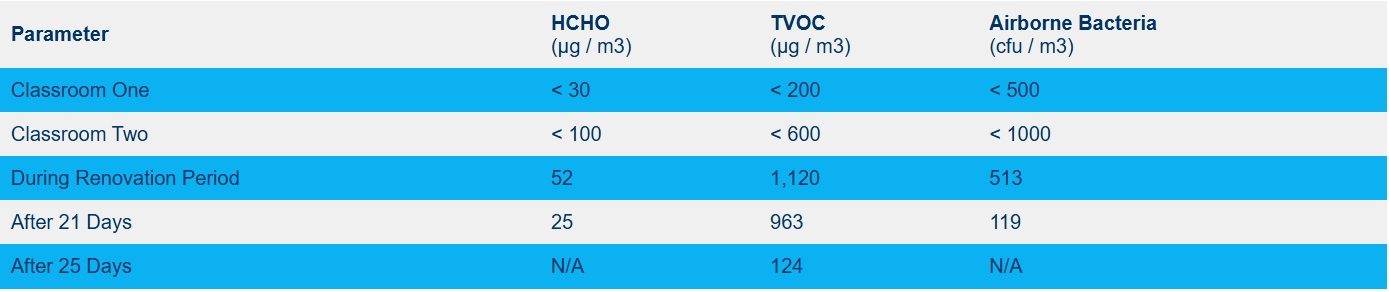
Following the successful installation of the Induct units, management witnessed significant improvements in IAQ and the creation of a more pleasant learning environment. Our comprehensive data analysis revealed within 25 days an impressive reduction in formaldehyde (HCHO) levels, indicating a substantial improvement in air quality. Additionally, the school experienced a remarkable 100% decrease in airborne bacteria, highlighting the effectiveness of Biozone Scientific solution.
Conclusion
Through collaboration with the Hong Kong international school, Biozone Scientific successfully implemented an indoor air quality solution designed to support classroom environmental management and improve overall IAQ performance.
By integrating the Induct Series into the school’s HVAC infrastructure, Biozone Scientific helped support improved indoor environmental quality, quieter operation and reduced maintenance requirements across the educational facility.
This project highlights Biozone Scientific’s ongoing commitment to supporting indoor air quality management across educational environments through scalable, HVAC-integrated commercial solutions.